

Results Q2: What do you think are the main risk factors for grass sickness?
Crucible Social Media Call Out
Once again we are very grateful to Andi Neilson, MSc, for analysing the results for us.
Question 2 What do you think are the main risk factors for grass sickness?
Figure 1 Hierarchy sunburst showing frequency overview Chart Showing Frequency of Responses to the Question “What do you think are the main risk factors for grass sickness?”

Figure 2: Chart Showing Overview Frequency of Responses to the Question “What do you think are the main risk factors for grass sickness?”

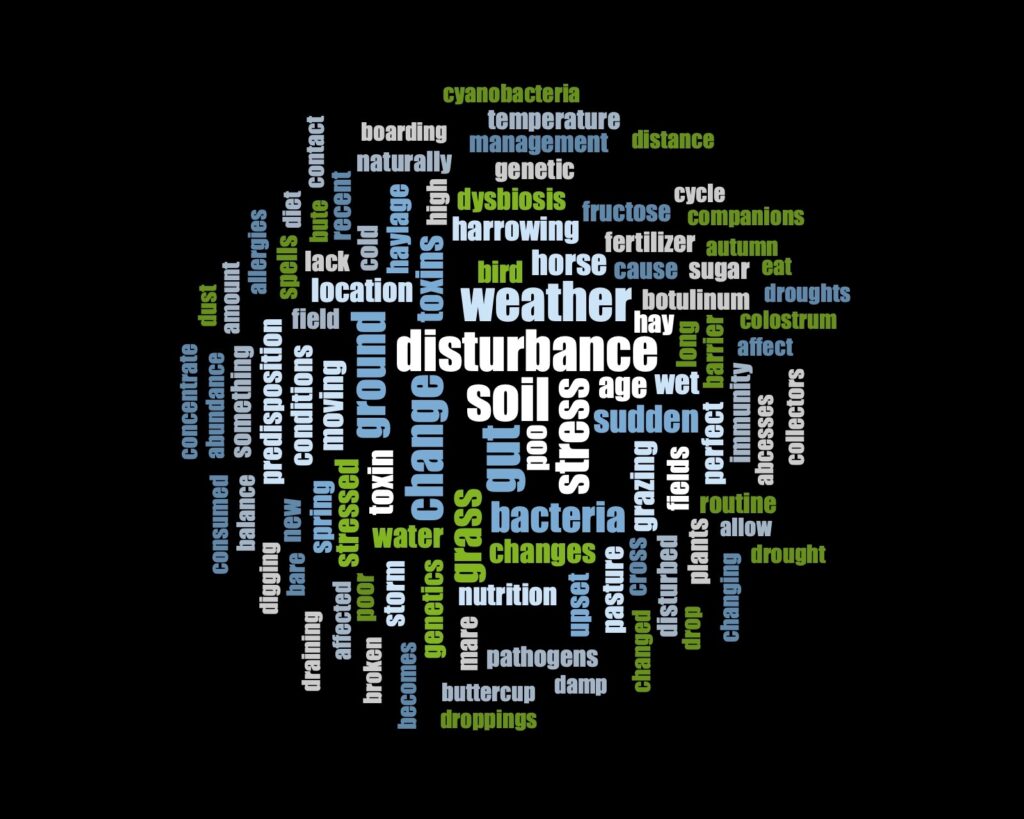
Figure 3. Word Cloud showing frequency of words used by respondents to the question “What do you think are the main risk factors for grass sickness?”
Soundbites:
• I think the reason the questions are still being asked shows how little is still known about this dreadful disease.
• My first question that I would ask you is what do you feed your mares when they are in foal and also lactating? The possibility of this condition could go right back to here in the search for answers.
• I lost a 14-year old mare, home bred, ad lib forage, no recent worming/changes to diet. Minimal stress, living in family group alongside sheep. A year later I lost a cat to Key Gaskell Syndrome (similar). Only connection was mole hills in field where horses grazed and she regularly caught moles – possible link to botulinum bacteria in soil?
• In the early 1900 ‘s the farm would have used fertilizer from Peru – made from bird droppings and probably rife with bacteria. I believe there was a survey/record of horses that died from EGS on farms in Scotland way back in the 1900s.
• In France, a friend lost her young mare last summer. She was 6 years old. she had recently been changed boarding. she wasn’t particularly stressed. The boarding area was right in the bird sanctuary with lots of birds. and the area was marshy. it had rained heavily for the past few weeks before she fell ill. stagnant water can lead to the development of cyanobacteria. we do not explore the trail of contaminated water. The search for botulism was negative.
• It was horrendous what she went through and we felt so helpless
• We have lost many over the years sometimes for more than one in a year then years without but difficult to find common denominators.
• Living in Victoria Australia. We have drought stressed grass every year and I haven’t heard of grass sickness here. Might be due to different grass varieties.
• I know 6 cases, 5 were from 2014 onwards one, I don’t know the year but it’s been approx. within the last 15 years. I can see the yards from where we are. So there has to be something. It all used to be one farm and its split up now.
• A perfect storm of many factors
• I wonder if ground water run off/underground springs that pass through areas with ground work going on can make it to fields that are actually nowhere near any soil disturbance.
• I always wondered if there is a predisposition to it running in bloodlines.
• Was a horse who usually had a high worm count.
• Wonder if he had received colostrum or not as a foal as he was a rescue horse with fairly unknown history (rumored to have been bottle fed but this is not a definite known fact about him).
• Lots of green parakeets in the area. Birds pooed in the water trough all the time. Always wondered if they carried same bacteria as the Peruvian guano bacteria?
At the Equine Grass Sickness Fund (EGSF), we are dedicated to one goal: finding the cause of Equine Grass Sickness and helping to protect future generations of horses, ponies and […]
Tickets are available for the upcoming Equine Grass Sickness Conference, held at the Moredun Institute on 25th March 2026. The link to buy tickets can be found here: https://www.tickettailor.com/events/equinegrasssicknessfund1/2026000 In-person […]
The EGSF office will be closed on Christmas Eve, inclusively until we return to office on 5th Jan 2026. The email inbox will not be monitored during this time, and […]