

New Equine Grass Sickness dashboard launched
Equine grass sickness (EGS) is a devastating and complex disease of equines, which unfortunately can occur anywhere in the UK, where sadly 80% of animals suffering from it will die. In a new approach for answers, the Equine Grass Sickness Fund (EGSF) and Moredun Research Institute (MRI) launched a new project three years ago. This project was designed to widen the research approach, engage with vets and horse owners and, importantly to establish a sample biobank and online case reporting system to improve surveillance of the disease and allow research to advance. Considerable progress is being made in all these areas, and today we are delighted to be able to report the launch of our new, real-time case reporting system and associated analytics dashboard based on anonymised EGS case reports.
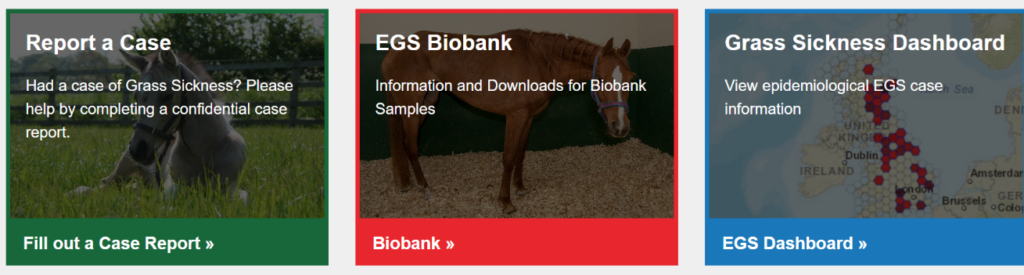
The new look dashboard on the front page of the Equine Grass Sickness Fund website Equine Grass Sickness Fund – A registered charity in the UK raising funds specifically for research into grass sickness
Collecting as much data as possible relating to an EGS case is vital in giving us leads to potential causes and risk factors for the disease and really can help direct research efforts. Working with the Equine Infectious Disease Surveillance (EIDS) team based at the University of Cambridge Vet School, and Dr John Grewar of jDATA, we have together developed a fabulous resource for vets, horse owners and researchers dealing with EGS cases. Both the case reporting system and analytics dashboard are now live but are undergoing further development to optimise their effectiveness and we are excited about future initiatives that will be of great help to owners on affected premises.
Anne Logan, EGSF Chair said, “Data collection plays a vital role in EGS research, not just for vets and scientists but also, most importantly, for horse owners. Our new real time reporting system will be invaluable in raising awareness and is another example of how important collaboration with other researchers is in the Fund’s quest for greater understanding of this complex disease and ultimately identification of a causal agent. I would urge all horse owners and vets to visit the EGSF website and engage with the new dashboard.”
Features of the currently available platforms are:
- An easier system for owners or vets to anonymously report the occurrence of cases of EGS and thereby provide valuable information for ongoing surveillance and research
- A streamlined first reporting section where basic anonymous information about a case can be promptly provided and through real time reporting thereby raise awareness for others on at risk premises and areas
- An analytics dashboard is now available based on the cases reported to the EGSF, allowing the occurrence of cases over time and across the UK to be visualised, and allowing owners to keep up to date on these occurrences
- The International Collating Centre (ICC), which provides a reporting system for equine diseases worldwide, will incorporate real time reporting of EGS cases notified through our system and in other countries, thereby improving our knowledge and understanding of EGS globally.
Dr Richard Newton, Director of Equine Epidemiology and Disease Surveillance at Equine Infectious Disease Surveillance (EIDS) at Cambridge Vet School added, “We are extremely pleased to see the exciting new outputs arising from EIDS’s collaboration with the EGSF and Dr John Grewar at JDATA. As advocates for disease surveillance and the benefits from timely awareness raising, it is fantastic to see the development of new systems for EGS case reporting and the visualising of EGS occurrence across the UK. These initiatives, alongside anonymous reporting of EGS through our own International Collating Centre, should allow UK horse owners to take prompt action to mitigate risks from this dreadful disease.”

The front page of the analytics dashboard is a work in progress and more information will be added as it develops
Dr John Grewar, JData, said, “It’s been a pleasure collaborating with Moredun’s EGS team and EIDS at the University of Cambridge to develop a real-time, web-based surveillance system for EGS. I look forward to seeing the positive impact this tool will have in deepening our understanding of this condition and, ultimately, enhancing its mitigation.”
In summary, the more data we have, the more accurate our results will be, so please report all cases, preferably right away, but even retrospectively is welcome! For further information, please contact Dr Beth Wells, Moredun at beth.wells@moredun.ac.uk
Donations towards the upkeep of the dashboard would be gratefully received at: https://www.grasssickness.org.uk/donate/
Tickets are available for the upcoming Equine Grass Sickness Conference, held at the Moredun Institute on 25th March 2026. The link to buy tickets can be found here: https://www.tickettailor.com/events/equinegrasssicknessfund1/2026000 In-person […]
The EGSF office will be closed on Christmas Eve, inclusively until we return to office on 5th Jan 2026. The email inbox will not be monitored during this time, and […]
Please note that the last day to order merchandise in time for Christmas is Tuesday 16th December. All orders will be sent out on Wednesday 17th December via second class […]